
ELEPHANTS RESOURCE / 12 MIN READ
An original Elephants in Main Street perspective, retained in the on-site knowledge bank for practical use.
THE COACHING LOGIC
Intentional change connects the future people want with the evidence they can act on now.
The five discoveries are revisited rather than completed once. Elephants uses them to connect strategic intent, an honest Snapshot, deliberate practice and supportive relationships around the real work.
Ideal self
The future worth moving towards.
ELEPHANTS: strategic intent, desired culture and leadership promise.Real self
The current pattern, evidence and gap.
ELEPHANTS: Snapshot, live data and candid dialogue.Learning agenda
The few capabilities worth building now.
ELEPHANTS: a strategy-linked development plan and coaching focus.Experiment
New habits tested in the work itself.
ELEPHANTS: Super Leaders, team practice, coaching and transfer.Resonant relationships
People who encourage reflection, learning and follow-through.
ELEPHANTS: coach, sponsor, peer network and review rhythm.The loop returns to strategic intent as the evidence changes: purpose → reality → learning → practice → reinforcement.
THE MEASURABLE COACHING SERIES
Make the development work visible without turning the person into a score.
Align
Name one strategic or development-plan outcome that matters.
Baseline
Agree the metric, owner, target, direction and evidence cadence.
Coach
Turn the gap into a small learning agenda and practical experiment.
Review
Check the actual result, system-level why, action and support needed.
Transfer
Reset the plan, sustain what works and carry the learning forward.
Max Q provides a shared progress language for the agreed outcome. The coaching question stays human: what does this evidence tell us about the system, the leadership action and the next useful experiment?
In a pressured workplace, it is easy for leadership conversations to become a rapid exchange of targets, facts and instructions:
- “What was committed?”
- “What has been delivered?”
- “What went wrong?”
- “What are you going to do now?”
These questions matter. They create clarity, expose gaps and keep work moving. Yet, used on their own, they can leave leaders with a familiar frustration: people become very good at reporting information, while the leader remains responsible for doing the real thinking.
Coaching changes that pattern. Its purpose is not to make performance conversations softer or slower. It is to help people examine their assumptions, understand the systems they lead and take fuller ownership of the next decision. Done well, coaching creates more capable people, more reliable forecasts and faster recovery when something goes off track.
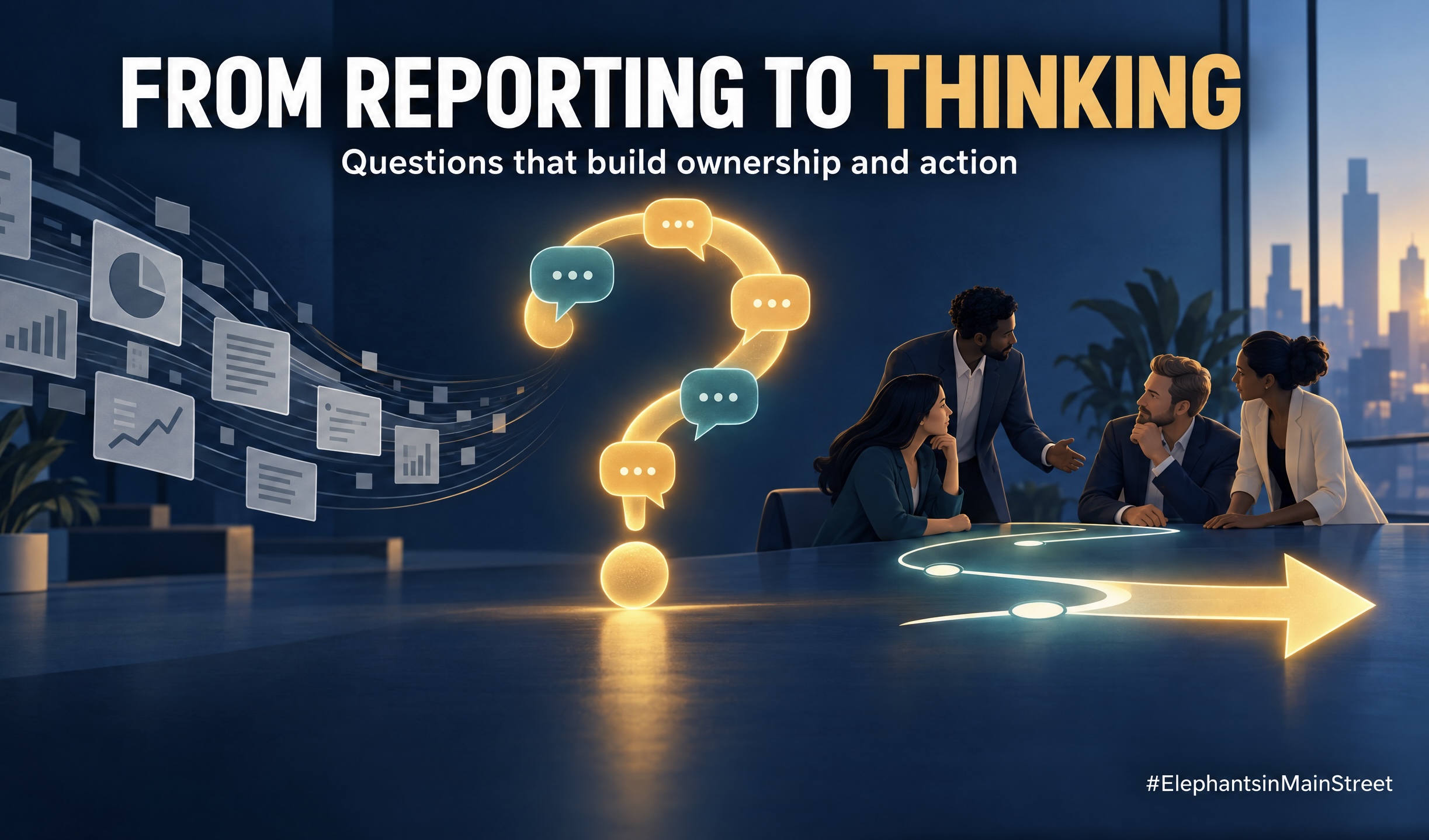
The shift is from asking for data to developing the thinking behind the data.
Management as service
At its best, management is a form of service. It creates the conditions in which people can think well, act responsibly and deliver work that matters.
This does not mean that a manager must have every answer, nor does it mean avoiding difficult conversations. It means being clear about the required outcome, helping people understand what is producing the current result, and returning responsibility for action to the appropriate owner.
A coaching leader therefore does three things consistently:
- Makes standards visible. People know the outcome, timing, quality and safety requirements.
- Invites sound thinking. People are expected to explain their reasoning, not merely provide a status update.
- Builds ownership. People leave the conversation knowing what they will do, how progress will be measured and when they will report back.
This is especially important when leaders feel pressure to step in and solve the problem themselves. Stepping in can be necessary. However, if it becomes the default response, the team learns to wait for rescue instead of strengthening its own judgement.
The three levels of a productive leadership conversation
A useful framework is to organise questions across three connected levels: management routines, system and Integrity based conduct.
Management routines
This level examines commitments, targets, timing, priorities and the visible performance gap. Ask: “What was agreed?” “What has actually happened?” “What is the gap?” The aim is a shared, fact-based view of performance.
System
This level examines process flow, assumptions, controls, capability, constraints, handovers and evidence. Ask: “Why did the system behave this way?” “What did we fail to understand, control or anticipate?” The aim is insight into the drivers of the outcome, not just its symptoms.
Integrity based conduct
This level examines ownership, judgement, candour, follow-through and care for people. Ask: “What is your part in this?” “What did you do when you first saw the risk?” The aim is responsible action, learning and trust. The management routines level is the most visible. It tells us whether the target was achieved. The Integrity based conduct level establishes the quality of leadership: whether people are candid, accountable and willing to act. The middle level—the system—is often where the greatest leverage lies.
A missed commitment may be obvious. The more valuable question is: what in the system, reasoning or decision-making caused the commitment to become unreliable? Until that question is explored, the same pattern may repeat under a different label.
Why “why” matters
A calm, purposeful “why” question can be one of the most powerful tools available to a leader. It invites people to make their thinking visible.
Compare these two exchanges:
Reporting
“The result will be late because the process is running behind.”
Coaching
“What led you to believe the original timing was achievable? Where did the plan first stop matching reality?”
The first response provides a fact. The second asks for the assumptions, evidence and decision points behind the fact.
This matters because people can sometimes present plausible information without having examined whether it is enough. A coach does not simply accept the first answer and move on. They help the person ask better questions of their own thinking:
- What did you know at the time?
- What did you assume?
- What evidence supported that assumption?
- What signal did you overlook or discount?
- What would you do differently if you faced the same conditions tomorrow?
The intention is not to interrogate, embarrass or conduct a ritualised “five whys” exercise. The intention is to uncover the judgement that sits beneath the action. Productive discomfort can be part of that process, but it should always be paired with respect, curiosity and a clear path forward.
A six-step coaching sequence for performance conversations
When delivery, quality, safety or a forecast is at risk, use this short sequence to structure the conversation.
1. Name the expected outcome
State the commitment precisely and explain why it matters.
- “We agreed this outcome by this time. Why was that commitment important?”
- “What standard are we trying to protect here?”
This anchors the conversation in a shared purpose rather than a personal disagreement.
2. Establish the actual position
Separate verified facts from assumptions, hopes and inherited views.
- “What do we know for certain?”
- “What is a forecast, rather than a fact?”
- “What information do we still need before we can make a reliable decision?”
A leader who distinguishes evidence from optimism improves both credibility and decision quality.
3. Explore the system-level why
Move from the symptom to the underlying operating reality.
- “Where did the plan first diverge from reality?”
- “What changed in the process, conditions, capability or handover?”
- “What did we not understand, control or anticipate?”
- “Which constraint is now setting the pace?”
- “What evidence would confirm or challenge this explanation?”
The leader does not need to be the deepest technical expert in the room to ask these questions. Their role is to ensure that the relevant expertise is brought to bear and that the explanation is grounded in evidence.
4. Test the reasoning behind the forecast
A forecast is a statement about the future. Ask what makes it credible.
- “What led you to be confident in that timing?”
- “Which assumptions must hold for this plan to work?”
- “What is the next point at which you will update the forecast?”
- “If your explanation is correct, what should we expect to see next?”
This turns forecasting from a hopeful declaration into a disciplined leadership practice.
5. Move decisively to recovery
Once the problem is understood well enough, shift into action.
- “What is your recovery plan?”
- “Who owns each action?”
- “What support is genuinely needed?”
- “What can be stabilised, accelerated or escalated safely today?”
- “When will we know whether the recovery is working?”
The question “why?” should not delay urgent action. In fact, it often accelerates action by clarifying responsibility and ruling out superficial responses.
6. Close the learning loop
Do not let the team treat recovery as the end of the matter.
- “What will change in the next plan, handover or forecast?”
- “What early signal will we watch next time?”
- “How will we prevent this becoming a recurring pattern?”
This is where coaching becomes capability-building rather than incident management.
Holding people accountable without making it personal
Accountability is often misunderstood as pressure, blame or a search for fault. In coaching, it is the willingness to own one’s judgement, choices and follow-through.
A respectful accountability conversation might sound like this:
“I value your experience. Help me understand the thinking and evidence behind this recommendation.”
This statement does two things at once. It recognises expertise and sets the expectation that conclusions must be accompanied by reasoning. That is particularly useful with experienced colleagues who may be accustomed to being trusted on the strength of their track record alone.
When someone reacts defensively, resist the temptation to argue about motives. Return to the practical purpose of the conversation:
- “I am not questioning your intent. I am trying to understand the thinking behind the decision.”
- “What would help us make the next forecast more reliable?”
- “What is your own assessment, based on the available evidence?”
- “What is the leadership action required from you now?”
The standard should be consistent: coordination and delegation matter, but senior leadership also requires visible engagement, sound judgement and a willingness to step into the work when it needs leadership attention.
Coaching in urgent conditions
Some leaders worry that a coaching approach is too slow for a fast-moving environment. The opposite is usually true when the questions are focused.
A ten-minute operational conversation can follow this pattern:
- Outcome: What did we need to achieve?
- Reality: What has actually happened?
- Cause: Why did the plan stop matching reality?
- Risk: What could make the situation worse?
- Recovery: What will happen next, by whom and by when?
- Learning: What must change in the next decision cycle?
This is not an invitation to analyse endlessly. Stabilise any immediate risk first, then ask only the questions needed to create clear ownership and an effective response.
Three practical habits to build this week
1. Ask one more question before offering the answer
When you feel ready to explain what should happen, pause and ask:
“What do you think is driving this?”
That short pause often reveals whether the person has already understood the issue—or whether they need help to think it through.
2. Make the evidence behind every forecast explicit
When someone makes a commitment, ask:
“What evidence makes that forecast credible, and what would cause you to revise it?”
This produces earlier escalation, fewer surprises and better planning.
3. End every difficult conversation with ownership
Before leaving the conversation, make sure the person—not the leader—states the next step:
“Tell me what you will do next, what success will look like and when we will review it.”
If they cannot answer clearly, the conversation is not yet complete.
The real purpose of coaching questions
The purpose of coaching is not to make leaders less direct. It is to make directness more useful.
Good questions help people connect an immediate decision to a wider purpose: safer work, more dependable delivery, stronger relationships and a more capable team. They show that accountability is not a punishment. It is how people learn to use their judgement well and earn trust through consistent action.
The next time a commitment is missed, resist the urge to move straight from “what happened?” to “here is what you should do.” Hold the standard, ask what is true, explore why the system and thinking produced the result, and return ownership of the response to the person who must lead it.
That is how reporting becomes thinking—and how thinking becomes better action.
Intentional change: linking coaching to strategic intent
The coaching approach in this article is strengthened when it begins with the change the person, team or organisation is trying to create—not only the deficit that needs correction. Intentional Change Theory is useful here because it treats desired, sustained change as a set of discoveries that people revisit as they learn: a desired future or ideal self; an honest view of the present or real self; a learning agenda; experimentation with new habits; and resonant relationships that support the work.
For Elephants in Main Street, the same logic connects coaching to the wider process. Strategic intent and the culture people are trying to create establish the direction. A Snapshot, live evidence and candid dialogue help make the current reality visible. A learning agenda turns the gap into a few meaningful development priorities. Leadership and team practice create experiments in the work itself. Coaching, peer support and review conversations provide the resonant relationships that help the new habits travel.
This is not a fixed linear programme. A leader may return to the desired future after new evidence changes the picture, or revisit the learning agenda once a practical experiment exposes a constraint. The value of the model is that it keeps the work connected to purpose, reality, practice and relationship at the same time.
A measurable coaching series
A coaching series should make the strategic or development-plan outcome visible without reducing the person to a score. The metric is evidence about the agreed outcome; it is not a measure of someone’s worth or a substitute for judgement.
1. Name the strategic or development outcome
Start with one live outcome that matters to the strategy, team plan or personal development plan. For example: improve the reliability of a critical handover, increase customer-response quality, strengthen leadership bench readiness, reduce rework or improve the quality of forecast conversations.
2. Define the evidence and target
Agree the named metric, the accountable owner, the current baseline, target, direction of improvement and review cadence. Include both a performance measure and, where useful, a leading behavioural indicator. The metric needs a clear operational definition so that the coach and coachee are looking at the same evidence.
3. Turn the evidence into a learning agenda
Use the baseline to ask what needs to be learned, practised or redesigned. The learning agenda may concern judgement, stakeholder conversations, a decision rhythm, capability, a handover, the quality of evidence or the design of the system itself. It should be small enough to test in the work between sessions.
4. Run short practice-and-review cycles
Each coaching session closes with one or two owned experiments, a date for checking the evidence and a clear statement of what would count as progress. The next session begins with the actual result, the person’s interpretation, the system-level why and the next action. That makes the coaching series a disciplined learning loop rather than a sequence of good conversations.
5. Use Max Q as the shared progress language
Max Q expresses performance against the agreed target: Zero Impact is 0–30%; Crisis is 31–70%; Inertia is 71–100%; Breakthrough is 101–120%; Max Q is 121–180%; and Turning Point is 181% or above. Used carefully, these states help the leader and coach see whether the response should stabilise a risk, remove a constraint, consolidate a working practice or scale an emerging breakthrough.
The useful question is never simply “Which colour are we?” It is “What is the evidence, what is this state telling us about the system, and what experiment or leadership action will move the outcome responsibly?” The resulting record links strategic intent, the development plan, the coaching agenda, the action taken and the evidence reviewed in one place.
6. Review transfer, not just the session
At an agreed cadence, review whether the metric is moving, whether the new habit is being used in the work and what needs to change in the plan. Keep the learning even when the target is missed. That is how a coaching series produces practical data, better judgement and a development story that can be carried into the next strategic challenge.
A USEFUL NEXT STEP
What would this change in the way your people lead, decide or work together?
Bring the live question to the herd. We can help connect the thinking to your culture, leadership and strategic intent.
Start a conversation ↗