Collaboration when the evidence is incomplete

Forensic Investigation – The Crime Scene

Practising collaboration when the evidence is incomplete and the way forward is unclear

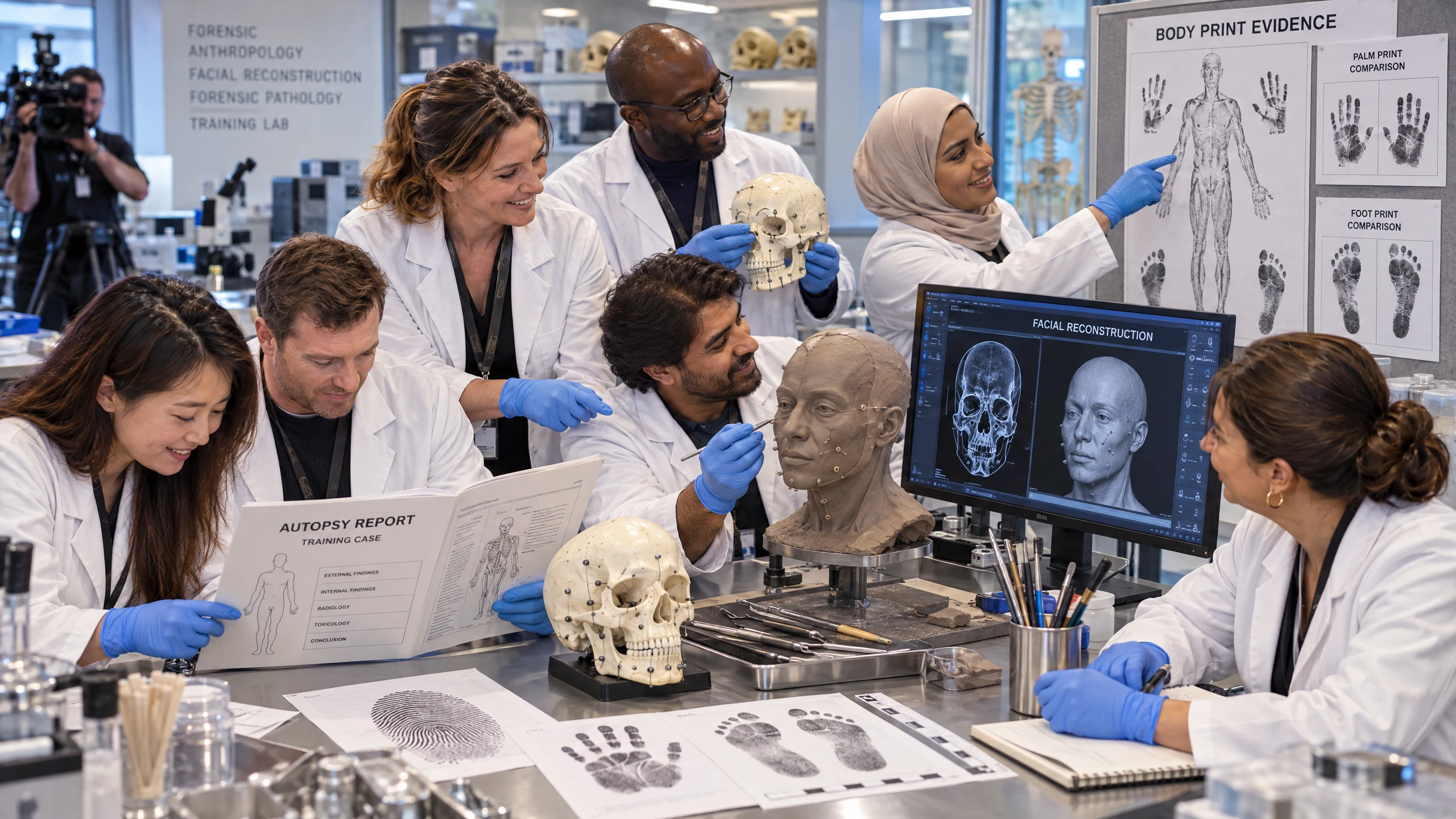
A diverse team exploring a simulated forensic training case using models, reports and evidence displays
Illustrative forensic training scene. Case materials and activities are agreed for your programme.

The scene is simulated. The collaboration is real.

Solve the case. Examine how you work together.

Our Forensic Investigation – The Crime Scene joins Movie Maker in our Signature Experiences. We place teams inside a compelling, reality-TV-style investigation, asking them to examine a realistic simulated crime scene, question assumptions and build a defensible explanation together. The scene is simulated and non-graphic; the uncertainty, competing interpretations and demands on collaboration are real. This is a facilitated team-development experience, not a professional forensic qualification. Participants are responsible for moving the investigation forward, rather than watching somebody else solve the problem.

The connection to business is immediate. Teams rarely receive perfectly organised information, complete agreement and an obvious next step. They encounter fragmented data, conflicting accounts, pressure to act and colleagues who see the same problem differently. Collaboration is messy, and telling people to collaborate more does not teach them how. We make those difficulties tangible, then model practical frameworks that people can try together, receive feedback on and carry back into their workplace.

The dramatic setting creates focus, but drama alone is not the learning. Who organises the evidence? Who jumps to a conclusion? What happens when someone questions the preferred explanation? A challenge outside everyday work makes familiar habits easier to examine without starting with accusations about a failed project. We provide structure, support and feedback so that difficulty becomes useful. Our purpose is bigger than solving the case: developing problem-solving, collaboration and adaptability when no individual has the whole picture.

TWO QUESTIONS, NOT JUST ONE

What does the evidence support—and how did the team reach its conclusion?

A shared challenge, not a ready-made answer

How the investigation becomes a learning process

We adapt the case, evidence materials and activities to your programme objectives. The sequence below explains the learning logic, rather than prescribing one fixed case or equipment package.

  1. 01

    Establish the challenge and the way of working

    We begin with the investigation brief, the task, its boundaries and the resources available. Our facilitator connects the challenge with a relevant business objective, such as better decisions, stronger cross-functional working or a more disciplined response to uncertainty. The precise case, evidence materials and activities are adapted to the programme design and the team's development objectives.

    Participants receive a workable starting point, not a promise that everything will be explained in advance. They decide how to divide responsibilities, keep track of information and bring findings together. Collaboration is already being practised: will they establish a shared approach, or work separately and assume coordination will happen later?

  2. 02

    Observe and record before explaining

    Participants examine the scene and the evidence provided through the scenario. Depending on its design, that may include physical clues, documents or recorded information. We help teams distinguish what they have actually observed from the story they attach to it. A clue is not yet a conclusion, an inconsistency is not automatically proof of wrongdoing, and confidence does not establish reliability.

    The team slows down enough to record what it knows, identify the source and make uncertainty visible. At work, the same discipline separates a verified result from a forecast, an assumption or a colleague's interpretation.

  3. 03

    Organise the data and expose the gaps

    As information accumulates, finding material gives way to making sense of it. Participants consider what is relevant, which accounts agree and where the evidence remains incomplete. An evidence map, timeline or shared record can give everyone something to inspect together, rather than leaving each person with a different version of events in their head.

    We encourage questions that improve judgement: what do we still need to know, which source needs checking, and what would distinguish two possible explanations? More information is not automatically better. Making gaps explicit helps the team direct its attention towards evidence that could genuinely change its understanding.

  4. 04

    Analyse alternatives rather than defend the first theory

    Teams form possible explanations and test them against the evidence. The first plausible story is a starting point, not a verdict. We encourage participants to examine contrary information, compare alternatives and explain what would change their minds, rather than noticing only material that supports their preferred theory.

    Putting people in the same room does not ensure that all relevant information enters the conversation. Familiar, shared information can dominate while an important observation held by one colleague goes unheard. The investigation gives teams a practical reason to draw out those contributions before settling on an explanation.

  5. 05

    Collaborate under uncertainty and make a reasoned decision

    Different participants notice different things and attach different importance to them. The team reconciles those perspectives without assuming that the most senior, vocal or confident person is right. Clear questions, explained reasoning, attentive listening and challenges directed at ideas rather than their authors are practical skills, not optional extras.

    We help the group consider when further investigation is useful and when it has enough evidence for a proportionate decision. Its conclusion should explain what the evidence supports, what remains uncertain and why alternatives were rejected. The aim is a decision the team can justify and revise, not certainty at any cost.

  6. 06

    Examine both the case and the collaboration

    Our facilitated review examines both the conclusion and the way the team reached it. A correct answer does not necessarily indicate strong collaboration: one person may have solved the puzzle while others remained disengaged. An imperfect conclusion can still offer valuable learning when participants identify where reasoning or coordination broke down.

    We explore specific moments, such as an overlooked clue, an unchecked assumption or a challenge that changed the investigation. The discussion remains useful, non-blaming and open to disagreement. Those observable events become the basis for learning a better approach and practising it again.

Collaboration is a skill, not an instruction

Make a better way of working tangible.

We model practical frameworks, help colleagues use them together and connect that practice with the next real business decision.

Facts
What is supported by evidence we can check?
Interpretations
What do we think the evidence means?
Unknowns
What still needs to be established?

Separate facts, interpretations and unknowns

We select and model frameworks for the team; these four examples illustrate practical working methods rather than proprietary model names. A shared record separates what the available evidence supports, what people believe it means and what still needs establishing. Even an apparent fact deserves a check of its source and reliability.

In the investigation, this stops a theory quietly becoming accepted as proof. At work, it helps colleagues distinguish a measured performance problem from an untested explanation of its cause. The framework becomes tangible because participants have experienced the confusion it addresses.

Build a shared evidence-to-decision trail

The team records the information considered, the explanation it supports and the questions still open. Reasoning becomes visible and available for shared examination, instead of remaining inside separate conversations. Colleagues can see the route from evidence to conclusion and where uncertainty remains.

We connect this method to project reviews, customer problem-solving and operational decisions. A shared trail helps people understand why a decision was made and what new information might justify revisiting it. Its usefulness continues after the crime-scene materials are packed away.

Use a constructive challenge routine

We model questions that test an explanation: what supports it, what contradicts it, and what alternative also fits the evidence? Participants are invited to contribute information that has not yet been heard, rather than simply repeat agreement. A quieter colleague's observation can then influence the decision.

The skill is challenging reasoning while respecting the person. Useful collaboration includes questioning, testing and revising ideas without losing the shared purpose or making disagreement personal. This routine helps teams avoid confusing consensus with accuracy, both in the simulation and at work.

Close the loop with ownership and review

A discussion ends with a clear decision or next question, an owner and an agreed review point. If the team cannot decide yet, it specifies the information needed and who will obtain it. Further investigation becomes a defined action, not a way of postponing responsibility.

The same routine travels into workplace meetings. Decisions can include a trigger for review if circumstances or evidence change. We make the approach practical through modelling, use and feedback: its value lies in how people work together, not how impressive a worksheet looks.

Cognitive experiential learning

Turn the investigation into workplace learning.

The challenge reveals working habits. Facilitation makes them discussable. Practice helps a better response become usable.

  1. 01

    Experience

    Our five-step learning cycle begins with action. The team encounters the investigation and responds to ambiguity, information and disagreement. Someone holds information others have not seen; someone wants to close the discussion; another person doubts the preferred theory. These concrete moments provide material for learning, rather than leaving collaboration as an abstract instruction.

  2. 02

    Analyse

    We help participants examine what happened. Where did information stop moving? When did an assumption become accepted? What helped the group progress? Structured reflection compares perspectives and stays grounded in observable events, rather than general judgements about personality. Our facilitation keeps the conversation useful and connects the shared experience with future action.

  3. 03

    Realise

    Participants identify connections to everyday work. They may recognise the rush to a solution in management meetings, reluctance to challenge a senior colleague or failure to combine information across departments. We help them make those connections without turning recognition into blame. The question becomes what the team can do differently when the pattern appears again.

  4. 04

    Learn a New Skill

    Our facilitator introduces or refines an approach that addresses the pattern. Participants practise separating evidence from interpretation, testing alternatives or coordinating the next action. Insight becomes a usable method: people see a framework modelled, try it themselves, receive feedback and examine what changes. The learning is something they can repeat on a real business problem.

  5. 05

    Practice to Mastery

    Mastery requires repetition, feedback and continued application. Completing the case does not complete that process. Our simulation offers an opportunity to begin and strengthen the skill; repeated workplace use helps it become part of everyday performance. A memorable experience can start a change, but it is not a guarantee of permanent change from one event.

Explore our experiential approach

A responsible simulation

Agree the setting, boundaries and participation.

We adapt the precise case, evidence materials and activities to the programme design and development objectives. The simulation can be configured for an appropriate delivery setting, subject to practical arrangements; portability should not be mistaken for an unconditional promise about any venue or format. The challenge needs enough structure, support and feedback to reveal working habits without creating confusion for its own sake.

Responsible design requires appropriate boundaries, sensitivity to participants' experiences and suitable access arrangements. Our crime scene is simulated and non-graphic: a credible investigation does not require real victim material, graphic content or a live criminal case. Accessibility and the appropriateness of the theme need consideration in planning. Where consent or privacy considerations affect participation or materials, they need addressing within the agreed programme boundaries, rather than being assumed.

Illustrative example, not a reported client result

Investigate the process—not a person to blame.

Consider an illustrative customer-service failure, not a reported client result. A team investigating repeated delays initially concludes that one department is not responding quickly enough. Discussion focuses on that department before anyone has examined the full sequence of events. Using the evidence discipline practised in our simulation, the team separates verified response times from assumptions, maps handovers and invites each function to contribute information others may not have seen.

One colleague identifies missing essential information when requests first arrive. Another highlights conflicting priorities that lead to repeated reassignment. The explanation shifts from blaming a department towards understanding how the process produces delays. The team agrees to improve initial information requirements, clarify handover ownership, assign responsibility and review whether delays actually fall. The learning is not forensic expertise: it is a more disciplined way to confront uncertainty, combine evidence, challenge an early explanation and coordinate action.

The frameworks travel with the team

Keep the evidence discipline. Leave the props behind.

The enduring outcome can be a shared evidence record, an agreed decision routine and specific commitments about working together, shaped to the programme and organisation. Unlike Movie Maker, the product need not be a film: it can be a visible method used in the next project meeting, performance review or customer problem-solving session. Questions such as 'Are we treating a theory as a fact?' and 'What information have we not heard yet?' give colleagues a shared reference. These frameworks do not depend on costumes, props or remaining in character.

Teams need opportunities to apply the methods to real tasks, receive feedback and review their collaboration. Leaders reinforce practice by asking for evidence, admitting uncertainty, welcoming relevant challenge and allowing time for sound judgement. Progress can become visible through clearer distinctions between evidence and assumption, broader participation, explicit ownership and willingness to revise conclusions. The organisation can then examine whether these improvements support better delivery in its own context. Business problems rarely have one pre-written answer; we develop a disciplined way of working, not an expectation of neat solutions or somebody to blame.

Connect it to your transformation journey

Create a shared way through uncertainty

Which decision needs more evidence—and better collaboration?

Bring your team context and development priorities. We will help shape an appropriate investigation and its workplace follow-through.